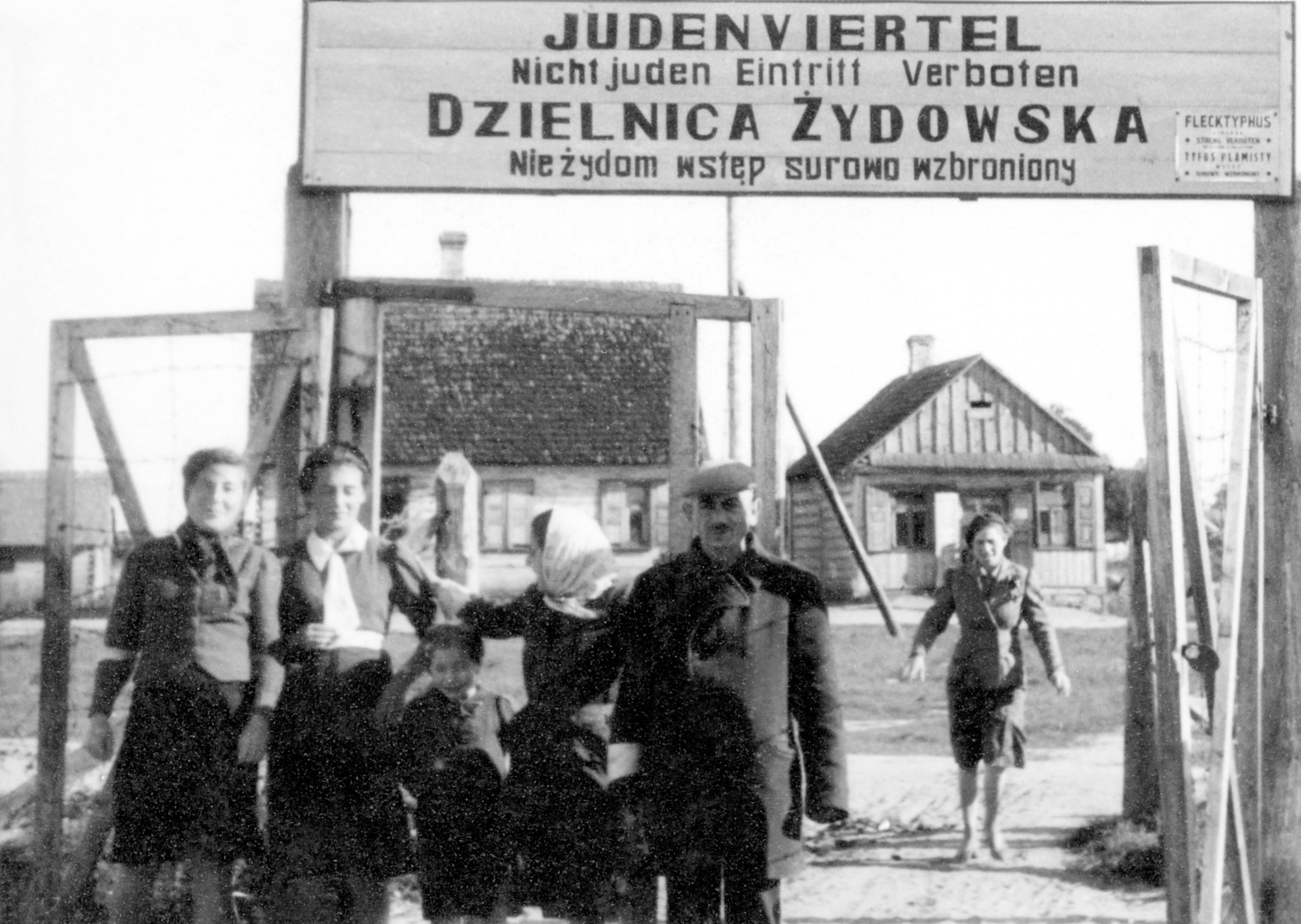

Propaganda nazistowska przedstawiała Żydów jako zagrożenie dla ludności aryjskiej. Jednym ze sposobów służących izolacji ludności żydowskiej było tworzenie gett. Tworzenie getta w Wisznicach rozpoczęto 22 września 1940 roku. Powstało ono jako jedno z pierwszych w okupowanej Polsce. Przymusowo zamkniętą dzielnicę zlokalizowano za Rynkiem Głównym. Od południa wyznaczał ją tzw. Koński Targ (dzisiejsza ul. Krótka), od wschodu ul. Fabryczna do ul. Żabiej (tzw. glinki), od północy i zachodu ul. Rowińska (łaźnia).
Na tym terenie znajdowało się zaledwie kilkanaście budynków mieszkalnych z 50 pokojami.W każdej izbie mieściło się po kilkanaście osób. Wyodrębnioną okolicę ogrodzono drutem kolczastym, przed którym wykopano szeroki rów. Do getta prowadziła brama główna od ul. Rowińskiej oraz brama pomocnicza od ul. Fabrycznej w kierunku Rynku. Na terenie getta nie było żadnej studni. Wodę dowożono beczką na jednokółce z Rynku. Do celów innych niż spożywcze wykorzystywano wodę znajdująca się na tzw. glinkach. Wybudowano jeden publiczny szalet.
Początkowo do dzielnicy żydowskiej można było swobodnie wejść. Polacy nadal korzystali z usług żydowskich krawców i szewców. W późniejszym okresie stało się to niemożliwe. Wejście na zamknięty teren groziło śmiercią. Żydzi, po otrzymaniu przepustki, mogli opuszczać getto do 1942 roku. Czynne były należące do nich przed wojną sklepy i 12 zakładów rzemieślniczych, które produkowały na potrzeby frontu.
16 grudnia 1940 roku do Wisznic przywieziono 925 Żydów z Mławy. Umieszczono ich w getcie. Miejscowa ludność żydowska powróciła do swych wcześniejszych domów, by wrócić tam ponownie w lutym 1942 roku.
W szczytowym momencie w Wisznicach znajdowało się ok. 1800‒2000 Żydów, w tym 834 rodowitych mieszkańców gminy. W lipcu 1941 roku w getcie przebywało 1016 osób, z czego 550 wysiedlonych i 466 miejscowych. Ten poziom w przybliżeniu utrzymywał się do czasu likwidacji getta 12 sierpnia 1942 roku.
Na zamkniętym terenie panowały tragiczne warunki bytowe. Głód i choroby dziesiątkowały mieszkańców. Szczególne pogorszenie nastąpiło po przybyciu do getta Żydów z Mławy. Miejscowa Delegatura Żydowskiej Samopomocy Społecznej (ŻSS), którą kierował Szymon Rajza, później Kuperkach Uszer, opanowała katastrofalną sytuację żywnościową dopiero przy pomocy American Jewish Distribution Committee oraz dzięki wielkiej solidarności lokalnych Delegatur ŻSS ze Sławatycz, Opola, Parczewa, Białej Podlaskiej. Polakom zabroniono udzielania jakiejkolwiek pomocy ludności żydowskiej. Za nieprzestrzeganie zakazu groziła kara śmierci.
Panujący głód zmuszał Żydów do nielegalnego opuszczania getta i chodzenia „po prośbie” lub wyprawy do chłopskich kopców po ziemniaki. W dalszym ciągu próbowano prowadzić handel wymienny, jednak najczęściej ludność żydowska przymierała głodem.
Żandarmeria strzelała do tych, którzy przechodzili przez druty ogrodzenia w poszukiwaniu żywności. Strzały rozlegały się codziennie w miejscach pracy, w getcie, w okolicznych lasach. Po tych wydarzeniach nazwiska żandarmów: Pudel, Reich, Messel, Giering, Bozeniusz Reinchold na trwale zapisały się w pamięci starszych mieszkańców Wisznic.
The Jews of Wisznice in the inter-war period
The origins of the Jewish community of Wisznice date back to the latter half of the XVII century.
The oldest recovered records regarding the Jews in the region come from years 1676-1677 when the Jewish Diaspora
of the Brzeski county of the Grand Duchy of Lithuania in Wisznice was supposed to count 129
individuals. The Hebraic map of the Council of Four Lands developed in 1667 makes a note of Wisznice village –
a proof that Jews resided there.
Prior to outbreak of the First World War the population of Wisznice counted 3140 residents of whom 1823 were
Jews. In the interwar period the number of the residents of the Jewish faith decreased by
half to the level of 990 individuals and constituted a half of the residents. The village was known across the entire region for
its weekly markets and two county fairs. The characteristic terraced architecture of Wisznice
with a distinctly separate Plaza and the main Dubicka and Kościelna streets along with the Rowinśka street
running from the north to the south next to the ku Wygodzie church imparted
the characteristic Jewish look and character upon Wisznice. Almost all buildings were constructed from timber. The houses located near the Plaza and along the streets
served as shops, market stalls, taverns and crafts workshops whereas the buildings located in the rear
served as living quarters. Jews enjoyed and played the dominant role in the local economic
life, i.e. in commerce, crafts and services.
Residents of Romanów and Opole municipalities were members of the Jewish Religious Community of
Wisznice.The Jews of Wisznice had access to a wooden synagogue, a mikvah, a ritual slaughterhouse, a denominational
school, a shelter and a Jewish cemetery.
The Ghetto
The Nazi propaganda depicted the Jews as a threat to the Aryan population.
One of the methods of isolating the Jewish population was establishing ghettos. The groundwork for establishing the ghetto
in Wisznice was laid down on the 22nd of September 1940. It was one of the first ghettos
in the occupied Poland. The restricted-access district was established behind the Main Plaza. From
the south the border of the district was demarcated by the so called „Horse Market” (the contemporary Krótka street), from the east by the stretch of the Fabryczna street running to the
Żabia street (the so called „Clays”), from the north and the east by the Rowińska street (the bath house).
In this area there were merely between ten and twenty residential buildings with 50
rooms. There were dozen or so persons living in each room. The area was fenced off
with barbed wire in front of which a wide ditch was dug. The main gate leading to the ghetto was located on
the Rowińska street with an auxiliary gate on the stretch of the Fabryczna street running towards the Plaza. There were no wells
in the ghetto. Water was delivered from the Plaza in a water cart. For purposes other than consumption
the water located in the so called „Clays” was used. One public restroom was erected.
Initially access to the Jewish district was not restricted. Poles continued to make use of
services of Jewish tailors and cobblers. This became impossible in the later period. Entering
the restricted zone could result in death. Until 1942 Jews could leave the ghetto upon receiving a
a leave pass. The shops and the 12 crafts enterprises producing goods
for the war effort owned by Jews prior to the war continued to operate.
On the 16th of December 1940 925 Jews from Mława were brought to Wisznice. They were placed in the
ghetto. The local Jewish population returned to their former houses just to return there
once again in 1942.
At its peak the Jewish population of Wisznice counted approx. 1800‒2000 Jews, including 834
native-born residents of the municipality. In the July of 1941 there were 1016 persons in the ghetto, including 550
displaced persons and 466 local residents. This or similarly numerous population of Jews maintained until the ghetto was closed down
on the 12th of August 1942.
The living conditions in the ghetto were abysmal. Famine and diseases were decimating
ghetto’s residents. The conditions deteriorated particularly severely after the Jews from Mława were brought to the ghetto.
The Jewish Social Self-help delegacy led by Szymon Rajza and later by
Kuperkach Uszer was able to contain the disastrous food situation only with the help of the American
Jewish Distribution Committee and due to assistance and solidarity of other local delegacies of the Jewish Social Self-help from
Sławatycze, Opole, Parczew and Biała Podlaska. Poles were prohibited from providing any
aid to Jews. Violating this prohibition could result in death.
The famine forced Jews to leave the ghetto illegally to „go begging”
or to venture to peasant potato mounds. Attempts were made at continuing
barter but alas, the Jewish population was starving.
The military police units were shooting at those who dared to cross the barbed wire fence in search
of food. Gunshots could be heard daily in workplaces, in the ghetto and in the surrounding forest. Following
these events the names of military police officers: Pudel, Reich, Messel, Giering, Bozeniusz Reinchold were permanently etched
in the memories of the elderly residents of Wisznice.
The mass murder of Jews proceeding since 1942 and referred to by the
culprits as „Aktion Reinhardt” claimed approx. 2 millions lives of Polish and foreign Jews.
The Jews of Wisznice were murdered in Treblinka. There was nothing left of the Jewish
residents of Wisznice, the characteristic old architecture of the village virtually disappeared. The younger
generation of Poles is not aware that prior to the Second World War every other resident of Wisznice was a
Jew. Only the memories of people who lived and worked here, the people who formed the local
community, remain. Therefore all efforts must be made to preserve the traces of their existence.
„They were here for centuries, they left forever … The Jews of Wisznice in the times of Holocaust” exhibition and the
accompanying catalogue shall contribute to restoring the memory of the natives – the neighbours
murdered by Germans during the Second World War.